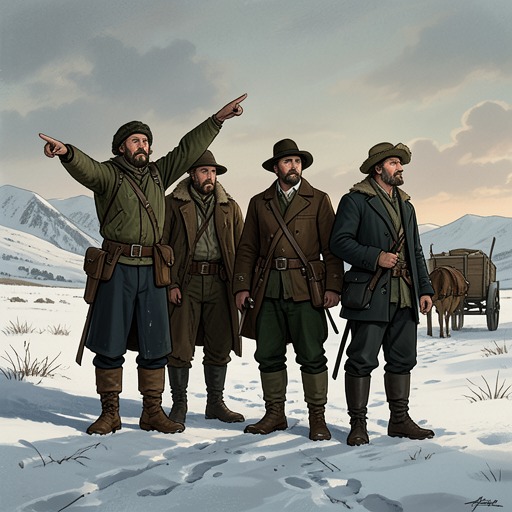
Abandoning the wagon and surviving the blizzard
Butcher's CrossingThe blizzard turns the expedition’s work into an immediate struggle to stay alive: the men must leave their wagon, keep hold of their animals, and make shelter from the Bison hides they have spent the season collecting. The storm does not merely interrupt the hunt. It scatters much of its material reward across the plateau, reduces the landscape to featureless white, and makes the hides a fragile barrier between the hunters and the cold.
Causes and Setting
The party enters the storm after a season of killing American bison in a remote mountain valley. Its members have been driven by Miller’s determination to hunt the herd down, while the hides have accumulated into a valuable stockpile. The wider history of the expedition makes that pile part of a much larger depletion: Miller recalls that Kansas once held immense herds, but that the great hunts have left bones across the plains and only scattered animals where thousands were once seen. Here, however, the immediate danger is not the market or the decline of the herds, but weather that can destroy the hunters and their haul at once.
The first flakes fall while the men are still considering the day’s work. They sit listening in a stillness that has settled after the wind, and Fred Schneider’s gesture draws their attention upward. William Andrews initially greets the snow with a laugh, but the flakes grow rapidly denser. Miller turns the party back toward camp before conditions worsen. The change is abrupt: a few falling flakes become a storm that drives snow across the mountains like a barrage and strips the men of warmth and orientation.
Abandoning the Wagon
By the time the hunters reach the wagon, the wind has become too strong for ordinary movement. Miller decides that the wagon is slowing them down and orders William Andrews to hold the horses while he and Fred Schneider free the oxen. The decision sacrifices the expedition’s normal means of transport in favor of getting the people and animals through the storm. Andrews struggles to keep the horses together, his hands numb on the reins as snow and wind erase the surroundings.
Charley Hoge is already in severe distress. His amputation has left him with one usable arm, and during the storm he crouches with his eyes fixed on nothing, moving his lips as he repeats a prayer. When one of the freed oxen passes, the horses panic and knock Hoge down. Andrews lunges toward him, but the horses pull Andrews off balance and drag him through the snow. He manages to stop them by digging his heels down until they reach the grass beneath the drift. When he looks back, he cannot see the wagon, the oxen, or the other men.
Andrews searches by the shallow, irregular track left in the snow, but the wind soon covers it. He calls out without being able to hear a reply and eventually falls to his knees, still holding the reins. A distant shout gives him a direction. The wagon and three crouching figures emerge from the whiteness, and Miller comes forward to take the reins. Andrews’s fingers have cramped shut around the leather; Miller has to pry them loose. The reunion restores the party, but not its bearings. With the mountain pines gone from view, Miller rides ahead with his eyes closed against the wind, and the others follow him without being able to see the way.
Hides as Shelter
The men find the camp by recognizing its trees, the large stone where they had built their fire, and the aspen enclosure Charley had made for the horses. The storm has overturned some of the stored hides and blown others away. A small remnant of the pile that had not yet been packed lies partly buried in snow; much of the rest has vanished into the valley or become caught among the pines. The expedition’s commercial cargo is now both exposed wreckage and the only available material for shelter.
Fred Schneider cuts the frozen straps with a small pocketknife. As soon as the hides loosen, the wind lifts a dozen of them and scatters them. Miller tells the men to take several apiece, then uses his knife and pieces of strap to join hides by their legs. With two hides laid fur-to-fur and others placed across them, he makes a rough, open-ended shelter wide enough for two men. He drags it against a growing snowbank and helps Charley Hoge into it. The arrangement is improvised, but Miller explains its practical purpose: it will keep the men from freezing, though it will not make them warm.
Schneider insists on making his own shelter. Miller and Schneider face one another in the blowing snow before Miller gives him the remaining straps and leaves him to work alone. Miller takes William Andrews away from the hide pile and sets up another shelter beside the one holding Hoge. Andrews has so little feeling in his fingers that he cannot handle the frozen pelts precisely; a gust knocks the hides onto him, and he falls while trying to pass them to Miller. The work of shelter-making is therefore not a display of effortless skill but a fight against cold hands, wind, and failing strength.
The Snowbound Days and Emergence
Under the hides, Andrews gradually regains enough warmth to rest. The rigid cover presses down as snow accumulates, and the wind’s roar becomes a muffled sound above him. For two days and three nights, the hunters remain trapped beneath the snow. They emerge only occasionally for relief or to dig air holes into the drifts covering their hide shelters. Andrews sleeps for much of the time, curled on his side with his knees drawn up, and remembers his home in Boston only as faint, remote sensations rather than as a world he can easily return to.
On the third morning he digs upward through the snow and emerges into intense sunlight. The valley he had known has been remade: drifts form frozen-looking waves across its floor, snow buries the mountain slope, and only the tips of some pines show above the white. The familiar ground seems strange again. His eyes hurt in the glare, and he has to rub them with melting snow before he can take in the landscape. The storm’s end thus brings no simple return to the earlier scene; it reveals a transformed valley and a party that has survived by sheltering inside the materials of its own hunt.
Significance
The episode reverses the expedition’s relation to its Bison hides. The hides had been gathered as the outcome of a commercial hunt, but when the storm destroys much of the stockpile, a few become essential equipment for survival. The same material that records the slaughter of the herd protects the hunters from the weather that overwhelms their plans. That reversal sharpens the distance between human ambition and the conditions of the natural world: the men can kill animals and collect their skins, but they cannot control the storm or preserve the landscape they have crossed.
The blizzard also makes the party’s dependence on Miller concrete. He recognizes when the wagon has become a liability, organizes the release of the oxen, finds the camp, and builds workable shelters from what remains. Yet survival is collective and precarious: Andrews holds the horses, Schneider makes his own shelter, and Hoge must be brought into cover while mentally overwhelmed. The storm’s whiteout strips away the expedition’s familiar landmarks and routines, leaving the men to one another, the animals, and the hides beneath which they wait.